
As large language models and AI foundational technologies rapidly advance, the industry is shifting from single-task models toward general-purpose intelligent agents. NVIDIA’s NitroGen model exemplifies this trend. Built on the OpenVision architecture, it breaks free from the confines of application-specific AI systems and strives to become a versatile agent capable of navigating diverse virtual worlds with ease.
In terms of data acquisition, the research team took an unconventional approach by turning to the vast troves of gaming videos available on YouTube and Twitch that feature controller overlays. Long overlooked by academia, these videos contain rich human player operational logic and decision-making patterns. By analyzing footage from over 1,000 games, NitroGen learned to translate visual feedback into action commands. According to AI industry observers, the team innovatively combined template matching with a fine-tuned SegFormer model to precisely extract real-time player button inputs, offering a new paradigm for AI systems to learn complex actions.
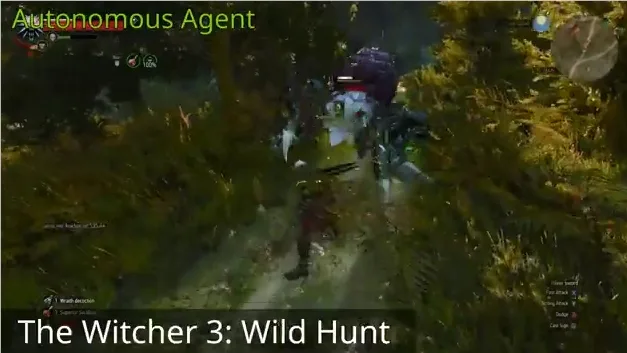
On the technical architecture front, NitroGen deeply integrates NVIDIA’s previously released GR00T N1.5 robot model, giving it outstanding cross-platform adaptability. Test results show that the model efficiently handles a wide range of game genres, including action role-playing games, platformers, and roguelikes. Notably, when faced with completely unfamiliar game environments, NitroGen achieved a 52% higher success rate compared to models trained from scratch. This performance gap underscores the general value of robot foundational models in virtual contexts and provides a valuable technical reference for the AI industry.
To accelerate the development of universal AI agents, NVIDIA has open-sourced the NitroGen paper, source code, and training dataset, in collaboration with leading academic institutions such as Stanford University and the California Institute of Technology. This initiative not only lowers the barrier to AI research but also offers the global AI community a wealth of resources for studying embodied intelligence, potentially driving the industry toward more efficient and general-purpose solutions.