
NVIDIA’s recently launched official guide to LLM fine-tuning marks a significant step in the widespread adoption of large language model technology. The guide systematically details how to efficiently customize large models on the full range of NVIDIA hardware platforms—from GeForce RTX laptops to DGX Spark workstations—using the open-source framework Unsloth. This move breaks the traditional reliance of fine-tuning on specialized equipment and high-end computing resources, allowing more developers to participate in personalized AI development and advancing the democratization of AI computing power.
Unsloth, an open-source fine-tuning accelerator built specifically for NVIDIA GPUs, has been deeply optimized across the entire LLM training pipeline, achieving perfect compatibility with CUDA and Tensor Core architectures. Compared to the traditional Hugging Face Transformers implementation, this framework delivers approximately 2.5x faster training speeds on RTX series GPUs while significantly reducing memory usage. This technical breakthrough means that a single consumer-grade laptop equipped with an RTX 4090 can now handle fine-tuning tasks that previously required multi-GPU server setups—greatly improving AI development resource efficiency and lowering the cost of deploying large model applications.
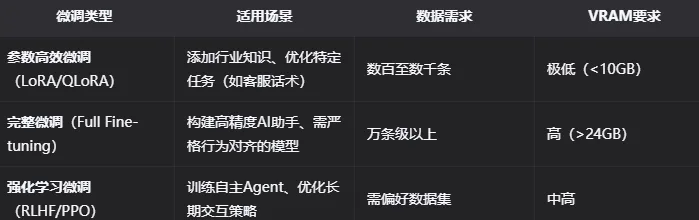
NVIDIA’s new guide also provides a detailed comparison of three mainstream fine-tuning methods, helping developers choose the best technical path based on their specific needs. This categorized guidance fully accounts for the varying backgrounds and hardware conditions of developers at different levels, ensuring that large model fine-tuning is no longer the exclusive domain of professional researchers. As these methods become more widespread, the AI industry will witness a more diverse innovation ecosystem, further enriching the application scenarios for large models.
A key strategy highlighted in NVIDIA’s guide is the “start small” progressive approach to fine-tuning. Users can begin by fine-tuning a 7B-parameter model using QLoRA on a lower-end RTX 3060 GPU, then gradually expand to larger models as experience and resources grow. This phased method lowers the entry barrier, while NVIDIA’s provided Docker images and Colab examples further simplify deployment, delivering an “out-of-the-box” development experience. This accelerates the adoption of AI technology across industries, giving small and medium enterprises and individual developers equal opportunities to participate in AI innovation.