
Amid the escalating race to scale large AI model parameters, Meta AI’s research team has taken a contrarian approach. Their newly released Pixio image model proves the philosophy of “less is more.” For years, masked autoencoder (MAE) technology was believed to lag behind more complex algorithms like DINOv2 or DINOv3 in scene understanding. Yet Pixio has completely overturned this conventional wisdom, redefining the trajectory of AI vision model development.
Pixio’s technical breakthrough stems from a deep re-engineering of the 2021 MAE framework. Meta AI researchers discovered that the original MAE architecture’s weak decoder severely limited overall performance. To address this bottleneck, the team significantly enhanced the decoder’s processing power and innovatively transformed image masking from small discrete patches to large contiguous regions. This design forces the model to abandon simple pixel copying strategies and instead deeply learn the co-occurrence relationships of objects in images, 3D spatial perspective properties, and complex visual elements like reflections, thereby achieving higher-level visual understanding.

Architecturally, Pixio introduces multiple class tokens that aggregate global attributes, enabling the model to more precisely capture key information such as scene type, camera viewpoint, and lighting conditions. This innovative design not only enhances the model’s ability to understand complex scenes but also brings AI vision systems closer to human-like cognition, while reducing the memory bandwidth demands on AI chips.
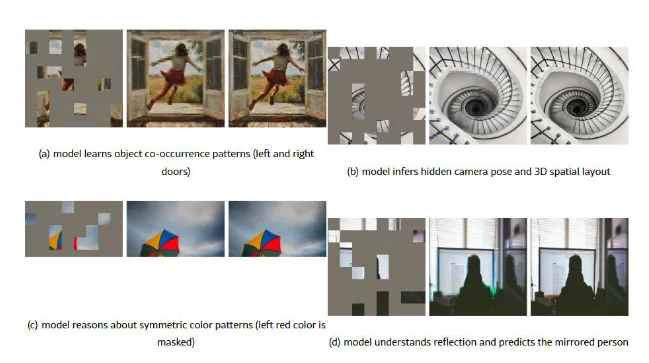
Notably, Pixio’s training strategy reflects Meta AI’s deep thinking about the essence of AI model training. Unlike the industry’s prevailing approach of optimizing for specific benchmark tests, Pixio was trained on 2 billion images collected from the internet, using a dynamic frequency adjustment mechanism—reducing the training weight for simple product images and increasing the training frequency for complex scenes. This training method, which does not “game” the test sets, actually endows the model with stronger generalization and cross-domain transfer capabilities, offering a new approach for efficient large AI model training and easing the computational burden on AI infrastructure.
Performance test data shows that despite having only 75% of DINOv3’s parameters, Pixio surpasses it on several key metrics. On monocular depth estimation, Pixio improves accuracy by 16%. In 3D reconstruction, Pixio trained on a single image even outperforms DINOv3 trained on eight views. In robotic learning applications, Pixio achieves a 78.4% success rate, leading DINOv2. These achievements fully demonstrate that in AI vision, innovation in model architecture and optimization of training strategies are more important than mere parameter scaling. They also signal a strategic shift in the AI industry from a “parameter race” to an “efficiency-first” paradigm.
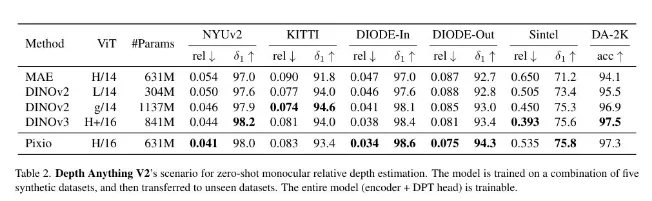
The research team acknowledges that Pixio still has limitations in manual masking design and will explore the possibility of extending it to video prediction in the future. Nonetheless, Pixio has successfully proven an important point: returning to the essence of pixel reconstruction often leads to deeper visual understanding. This insight not only provides important guidance for AI vision algorithm design but also offers a feasible solution for deploying high-performance AI models in environments with limited compute resources, potentially driving the intelligent upgrade of edge computing devices.