
As large-model technology continues to evolve in visual generation, AI video generation is undergoing a technological leap from single frames to long-form video. StoryMem arrives in an industry landscape where AI infrastructure is maturing and computing resources are becoming increasingly abundant, offering an innovative solution to persistent consistency challenges such as character face changes and scene jumps across shots. The framework maintains a compact, dynamic memory bank that stores keyframe information from previously generated shots, ensuring high cross-shot consistency through iterative generation. This breakthrough paves new pathways for AI chips in video generation applications.\n\nAt the core of StoryMem lies its unique "Memory-to-Video (M2V)" design philosophy. It first uses a text-to-video module to generate an initial shot as the base memory. For each subsequent shot, M2V LoRA injects keyframes from memory into the diffusion model, ensuring coherence in character appearance, scene style, and narrative logic. After generation, the framework automatically performs semantic keyframe extraction and aesthetic filtering to update the memory bank. This lightweight LoRA fine-tuning approach eliminates the need for massive long-video training datasets, significantly reducing computing power requirements and making professional-grade AI video generation more accessible to small teams and independent creators.\n\nIn experimental evaluations, StoryMem demonstrated outstanding performance. Test data shows it surpasses existing methods in cross-shot consistency by up to 29%, and achieved higher preference in human subjective evaluations. At the same time, StoryMem retains the high image quality, prompt adherence, and shot control capabilities of its base model (e.g., Wan2.2), supporting natural transitions and custom story generation.
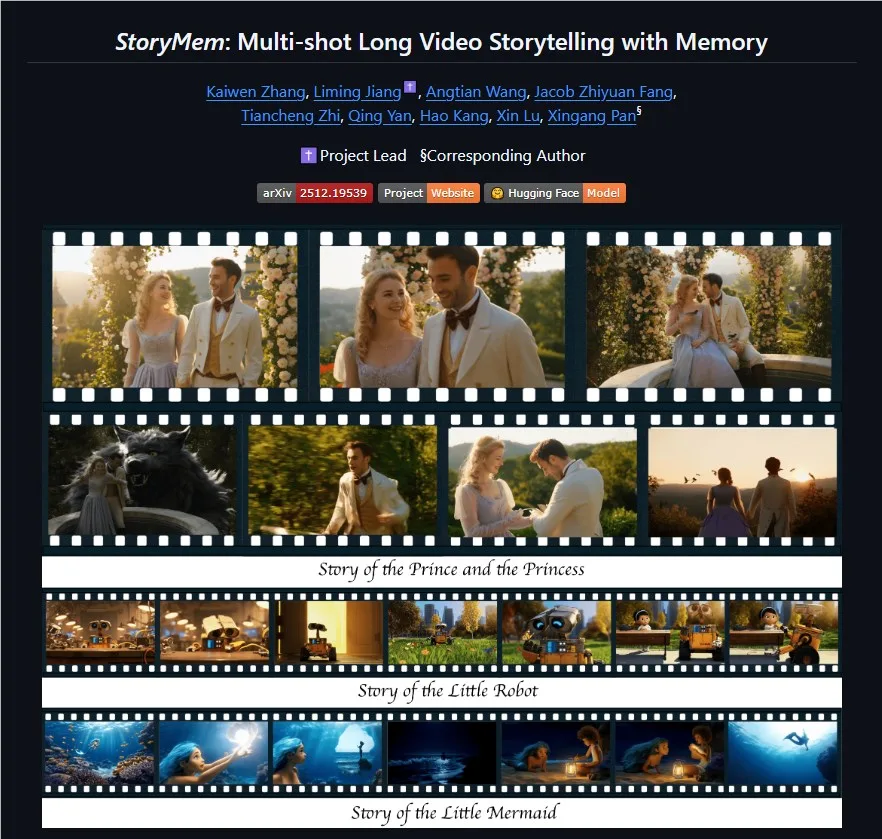
To promote technical standardization in this field, the team also released the ST-Bench benchmark dataset, comprising 300 diverse multi-shot story prompts. This provides an evaluation benchmark for computing power optimization and model training in AI video generation, driving industry-wide progress.\n\nIn terms of application scenarios, StoryMem is especially suited for areas requiring rapid visual content iteration. In marketing and advertising, it can quickly generate dynamic storyboards from scripts for A/B testing multiple versions. In film pre-production, it helps crews visualize storyboards and reduce upfront conceptual costs. For short-video creators and independent producers, it enables the easy creation of coherent narrative shorts, elevating content professionalism. These use cases underscore the practical value of large-model technology in vertical domains, while offering clear direction for the further development of AI chips and computing infrastructure—indicating that the AI industry is moving from general-purpose capabilities toward deep penetration into specialized scenarios.\n\nNotably, within days of StoryMem's release, the community has already begun exploring local deployment possibilities. Some developers have built initial workflows in ComfyUI, supporting local operation for long-video generation. This demonstrates how open-source AI technology is rapidly forming a community-driven innovation ecosystem, lowering the barrier to entry. Such community-led innovation is becoming a key driving force in the AI industry, enabling cutting-edge technology to benefit a broader user base faster and accelerating the adoption of AI across various sectors.