
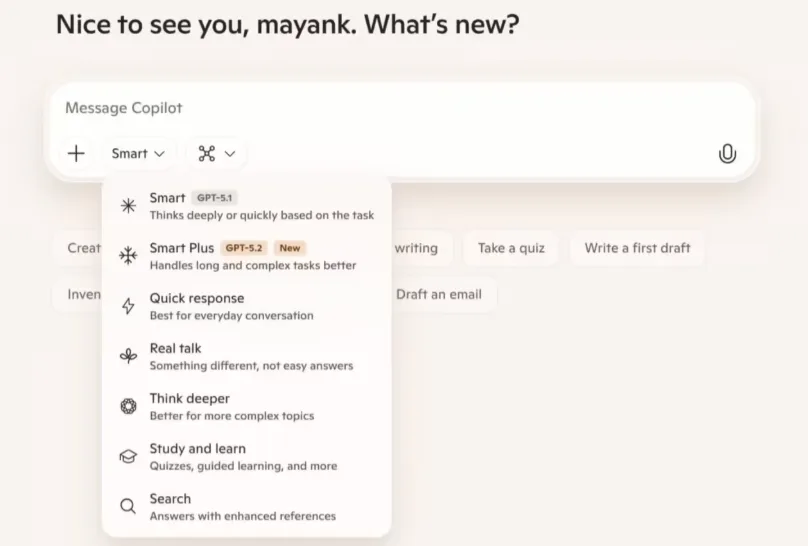
As a global technology leader, Microsoft’s latest Copilot overhaul goes far beyond a routine model iteration—it represents a significant expansion of AI’s role in real-world applications. The newly introduced GPT5.2 model is specifically enhanced with “thinking variant” capabilities, deeply optimized for office tasks that demand logical complexity and lengthy workflows. Against the backdrop of continuous breakthroughs in computing power, this model efficiently handles professional work ranging from constructing complex Excel spreadsheets and crafting polished PowerPoint presentations to conducting in-depth code reviews and extracting summaries from long documents—showcasing unprecedented professional competence.
According to Microsoft’s official Knowledge-intensive Task Evaluation (GDPval) data, GPT5.2 has achieved or surpassed the level of human industry experts in over 70% of test cases—a qualitative leap from the previous GPT-5 model’s 38.8% score. The model also performed impressively in stricter technical benchmarks: it scored a perfect 100% in the AIME 2025 Mathematics Invitational and significantly outperformed its predecessor in the SWE-Bench Pro software engineering test. These results reflect the rapid breakthrough of large models’ specialized capabilities in specific domains, and signal a shift from general-purpose assistants to professional consulting roles.
Notably, the GPT5.2 “Smart Plus” mode is offered as a free upgrade to all Copilot users, underscoring Microsoft’s strategic calculus in AI infrastructure deployment. By lowering the barrier to advanced AI technology, Microsoft not only expands its user base and collects more real-world application data, but also accelerates the adoption of AI tools in mainstream office environments. This “technology democratization” strategy will further push AI from the lab into practical productivity tools, reshaping traditional office workflows.