
The core breakthrough of this update lies in the introduction of an intelligent research system powered by large language models. The system employs a hierarchical computing resource scheduling mechanism, offering two working modes: "Quick Scan" and "Deep Dive." The former relies on lightweight real-time retrieval algorithms, while the latter invokes distributed computing resources to perform semantic analysis and knowledge reconstruction across hundreds of open data sources. Notably, each report generated by the system strictly adheres to academic citation standards. This technical path combining AI with knowledge graphs represents a key direction for current enterprise-grade AI infrastructure development.
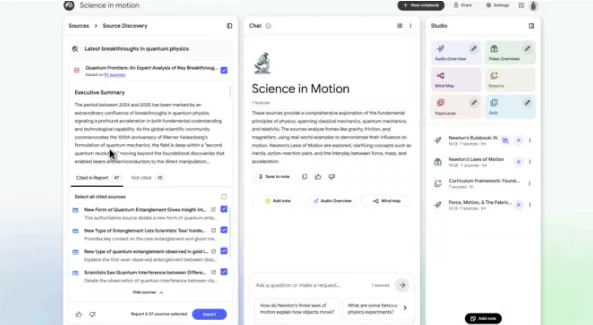
The expansion of file compatibility reflects a new trend in AI toolchain integration. By interfacing with the Google Drive API and Microsoft Graph, NotebookLM now enables intelligent parsing of cross-platform documents. Particularly, its ability to perform statistical modeling on tabular data highlights the performance breakthrough of AI chips in processing unstructured data. This multimodal fusion design aligns closely with the current AI industry's concept of "end-to-end knowledge workflows."
As a critical component of Google Workspace's AI transformation, NotebookLM has undergone three major iterations since its launch in 2023. From initial text summarization to now video content understanding, its evolution trajectory reveals the strategic layout of cloud computing giants in the AI office sector: using large models as a central hub to gradually absorb all aspects of traditional knowledge work. According to internal sources, the next phase of the product will focus on visual modeling, potentially sparking a new round of feature arms races among AI productivity tools.