
On November 2, Meituan released LongCat-2.5, a 1.6-trillion-parameter model that activates roughly 48 billion parameters per token, with the entire training run completed on domestic computing power. Section 4 of the technical blog states a key premise: the single-card memory of domestic computing power is less than 80GB.
Because one card cannot hold the model, multi-card parallelism becomes necessary. As card counts rise, parameter synchronization, expert-routing token dispatch, and KV cache movement all have to travel between cards, and communication time consumes computing power that should be used for computation. After running the numbers, many teams use domestic AI chips for inference and keep training on Nvidia.
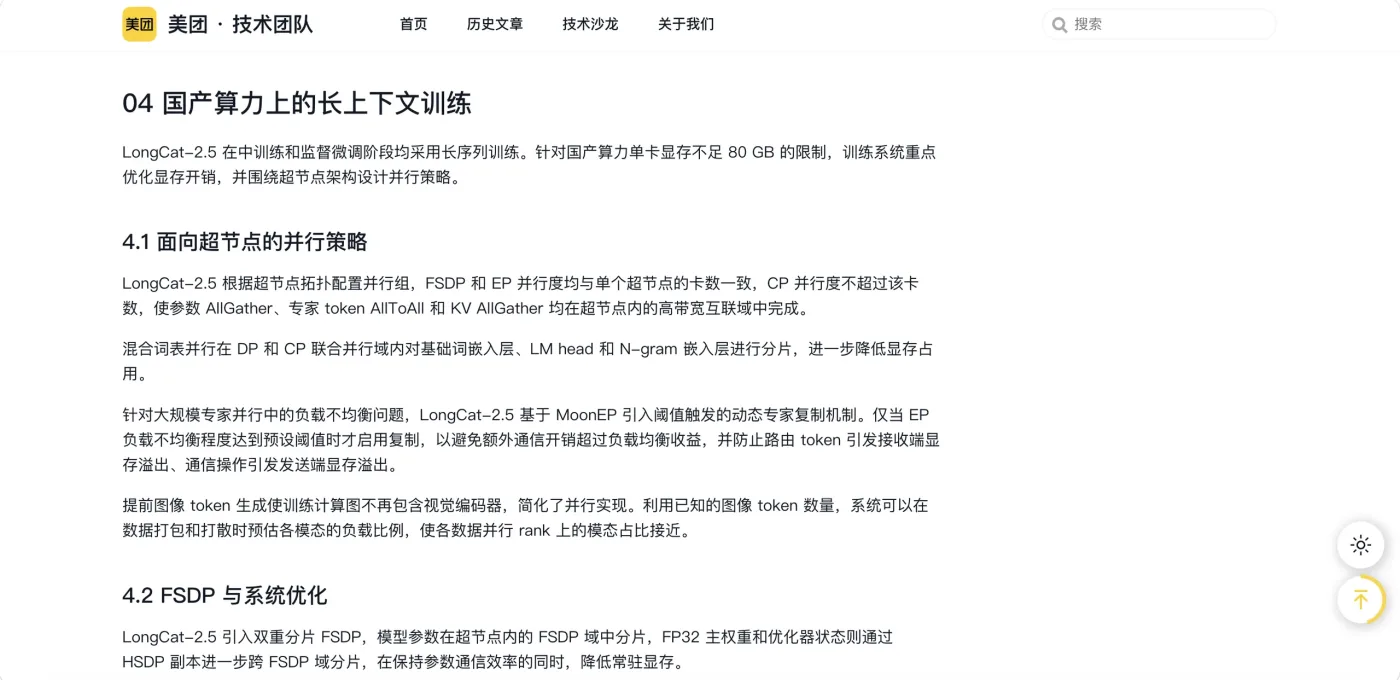
Meituan’s approach is to confine communication within racks. The parallel strategy is configured according to supernode topology, with FSDP and EP parallelism aligned to the number of cards in a supernode. Parameter aggregation, expert-token all-to-all exchange, and KV aggregation are completed within the supernode’s high-bandwidth interconnect domain, avoiding inter-rack traffic as much as possible. On long-context supervised fine-tuning tasks, per-card throughput improves by 86% over a DDP baseline—one card does the work of about 1.86 cards.
Training scale remains manageable: during mid-training, sequences reach up to 1 million tokens, with trillions of tokens accumulated in total. On the inference side, W4A4 quantizes both expert weights and activations to 4-bit. Compared with a W8A8 INT8 baseline, input and generation throughput both improve by about 40%, while time to first output is shortened by about 16%.
Enterprises that want to use this capability have two paths. Those training in-house must determine how much throughput long-sequence tasks can achieve on domestic cards; whether supernode interconnects work and whether parallel strategies are configured correctly directly determines how many times more card-hours the same task will require. Those adopting the model will use LongCat-2.5 for long-horizon agents, where a single task runs continuously for many rounds, putting pressure on inference concurrency and first-token latency.
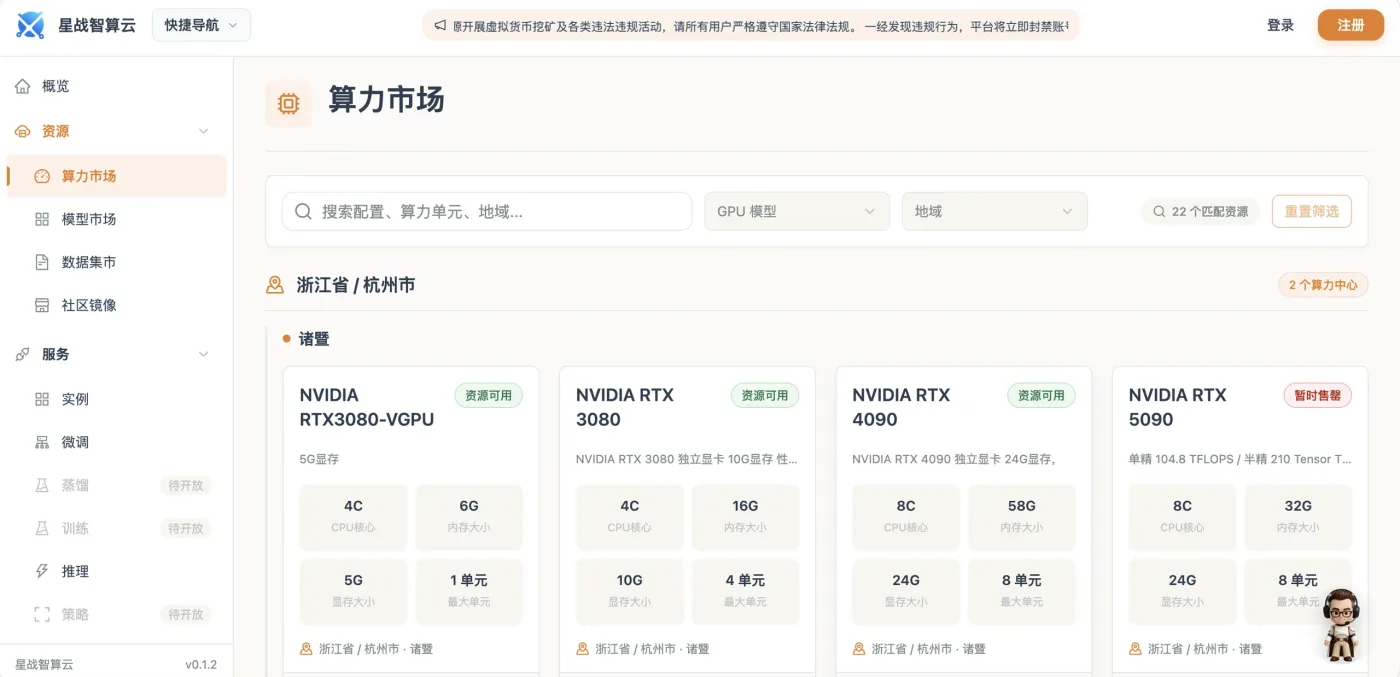
On the self-training path, teams do not necessarily need to build a data center first. StarWar GPUCloud supports data parallelism, model parallelism, and pipeline parallelism, and can submit multi-node, multi-GPU training jobs with one click. To stress-test long-sequence throughput, users can launch a set of instances and run a round of tests. Instances can be started and stopped on demand, billed by usage, and incur no charges when idle—stop them after testing. Once workloads are stable at volume, annual billing can be discussed, which is more cost-effective than provisioning a batch of cards for peak demand from the outset.

On June 30 this year, LongCat-2.0 completed full-process training and inference of a trillion-parameter model on a 50,000-card domestic cluster. On July 6, it was open-sourced under the MIT license, with Ascend, Moore Threads, and Muxi completing inference adaptation on the same day. LongCat-2.5 is the second consecutive generation.
Whether the cards are sufficient was already answered by the June run. For their own workloads, teams need to test two numbers: for the same long-sequence task, how many times more card-hours it costs on their own chip type; and how much downstream task accuracy drops after 4-bit quantization. The gap is narrowing, but it is not yet at the point where teams can switch with their eyes closed. These two numbers must be run on their own models and data—more useful than reading ten benchmark reviews.