
Amid surging demand for AI computing power, Microsoft’s latest Fara-7B model reinvents human-machine collaboration through a visual interaction mechanism. By employing pixel-level image recognition instead of traditional accessibility-tree-based methods, the system enables user devices to autonomously perform web operations. This breakthrough directly addresses a core pain point for enterprise applications: data leakage. From a technical standpoint, Fara-7B’s lightweight design not only reduces reliance on chip performance but also compresses the capabilities of larger models through knowledge distillation, offering a new approach for edge computing scenarios.
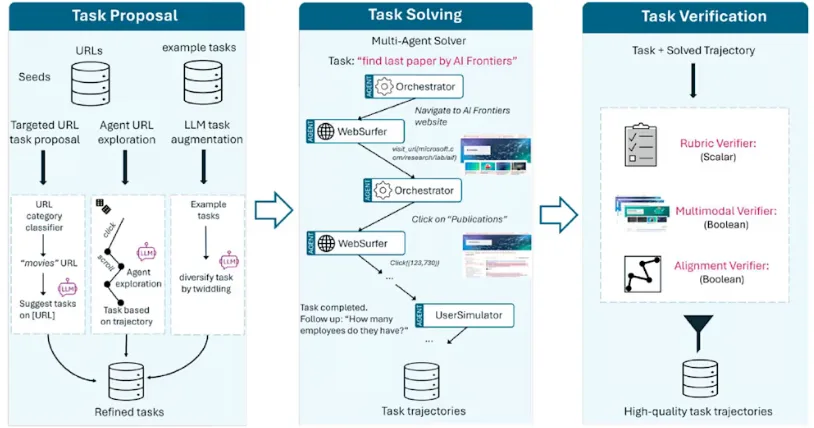
In terms of performance, Fara-7B achieves a 73.5% task success rate on the WebVoyager benchmark, significantly outperforming GPT-4o (65.1%) and UI-TARS-1.5-7B (66.4%). This efficiency advantage stems from its unique path-planning algorithm, which completes tasks in an average of just 16 steps—nearly 70% faster than comparable models. Notably, the model incorporates a "key point" identification mechanism that dynamically assesses risk and triggers user confirmation before sensitive operations. This proactive security strategy introduces a new protective paradigm for AI decision-making systems.
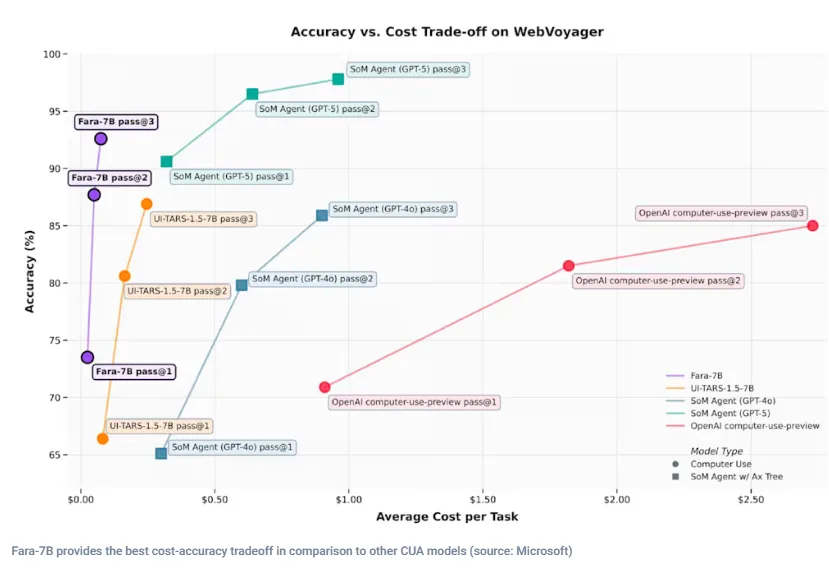
From an industry perspective, the launch of Fara-7B signals two important directions for AI infrastructure development. On one hand, the push for local deployment is driving chipmakers to accelerate the development of low-power AI accelerators. On the other hand, advances in model compression will reshape how large models are deployed. By releasing an MIT-licensed version on Hugging Face and Microsoft Foundry, Microsoft not only embraces open-source principles but also hints at a broader trend: enterprise AI applications migrating from the cloud to the edge.