
A new influential open-source AI model assessment, jointly released by renowned AI researchers Nathan Lambert and Florian Brand, provides a systematic analysis of large models developed by 35 institutions worldwide. The evaluation goes beyond technical benchmarks to incorporate factors such as community engagement, application breadth, and innovation impact. Notably, over half of the participating institutions are Chinese, highlighting the country’s rapid expansion and sustained investment in open-source AI—a stark contrast to the predominantly closed-source strategies of U.S. companies. This divergence underscores the different AI development paths chosen by the two nations.
DeepSeek’s R1 model stood out in the evaluation, delivering performance that approaches or even surpasses some top-tier closed-source models across multiple authoritative benchmarks. This achievement shatters the conventional belief that open-source models are inherently inferior to their closed-source counterparts, injecting new vitality into the open-source AI community. DeepSeek’s success stems from its focus on optimizing training algorithms and maximizing computing power efficiency, enabling high performance while lowering deployment barriers. This technical approach is particularly suited for small and medium-sized enterprises and research institutions with limited resources but diverse needs, offering a new pathway for democratizing AI technology.
Alibaba’s Qwen series, meanwhile, demonstrates strong industry adaptability. Through continuous technical iteration and ecosystem development, the Qwen family has spawned dozens of vertical models tailored to various industry scenarios—from financial risk control and medical diagnosis to smart manufacturing and education services. This expanding application footprint positions Qwen as a key vehicle for China’s AI technology to empower the real economy. The “general-purpose foundation model + vertical industry adaptation” development model ensures core technical consistency while meeting the differentiated needs of various sectors, making it a benchmark for commercializing large models.
Kimi pushes the technological frontier with its innovative approach, launching the world’s first trillion-parameter open-source large model and pushing AI model capacity to new heights. This breakthrough not only reflects China’s progress in computing infrastructure but also showcases the technical prowess of Chinese AI R&D teams in training and optimizing ultra-large models. The release of a trillion-parameter model enables developers and research institutions worldwide to conduct secondary innovation, accelerating AI’s iterative evolution. It also provides the global AI industry with more diversified technical options, reducing the systemic risk associated with a single technical path.
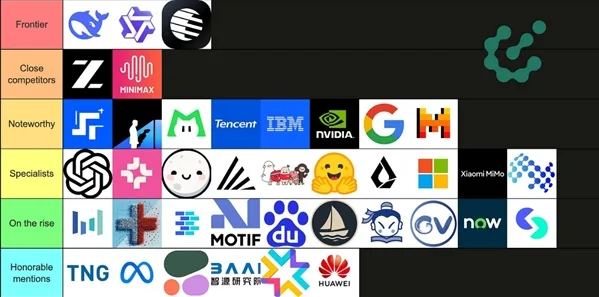
In the second tier of the ranking, Chinese companies such as Zhipu AI and MiniMax also performed prominently, each showcasing unique strengths in their specialized domains. Together, they form a comprehensive layout of China’s open-source AI models. This multi-layered, multi-field competitive landscape reflects the maturity and diversity of China’s AI ecosystem, offering more varied technical routes for global AI development. In contrast, U.S. open-source AI models performed mediocrely in the evaluation: OpenAI’s model ranked only in the fourth tier, while last year’s highly anticipated Meta Llama 3 slipped to the bottom of the list—a result that gives much food for thought.
The decline of the U.S. open-source AI ecosystem is no accident; it reflects a reassessment of open-source strategies by American tech giants. Reports indicate that Meta may adjust its open-source approach, redirecting more resources toward closed-source model development. This shift is closely tied to recent industry trends of surging AI R&D costs and increasingly centralized computing resources. As the exponential growth in computing power requirements for training and deploying large models continues, even tech giants struggle to sustain the cost pressures of the open-source model, prompting a transition from full open-source to a “partially open” strategy.
Currently, the global open-source AI field is undergoing profound transformation. Chinese companies, leveraging deep understanding of local market needs, flexible technical iteration strategies, and sustained R&D investment, are gradually establishing a leadership role in the global open-source AI ecosystem. This shift is reflected not only in technical benchmark leadership but also in comprehensive advantages in application deployment and ecosystem building. At the same time, the declining influence of U.S. open-source models reminds us that the boundaries between openness and commercialization in AI are being redefined. The line between open-source and closed-source may become increasingly blurred, and the future AI industry is likely to embrace a more diverse and complementary technical development landscape.