
Apple has detonated a technological depth charge in the AI industry with the open-source release of the SHARP model. Designed specifically for 3D content creation, this model uses an advanced large-algorithm architecture to compress reconstruction processes that traditionally take hours into less than a second, showcasing the potential of AI in efficient computing power utilization. Its core technology is based on 3D Gaussian splatting, where deep neural network training enables the model to predict millions of points with lighting and shadow information in a single pass, rapidly constructing physically accurate 3D scenes—a feat made possible by the large model’s mastery of massive spatial geometry patterns.

In terms of performance, SHARP resets industry standards. Test data shows that the 3D views it generates significantly surpass existing state-of-the-art models in texture detail and structural fidelity, supporting high-fidelity camera motion simulation. This breakthrough is underpinned by robust AI computing power, highlighting the advantages of large models in handling complex visual tasks. By releasing the complete code and assets on GitHub, Apple not only fosters open-source ecosystem growth but also provides global developers with innovative tools, accelerating the improvement of AI infrastructure and promoting efficient sharing of computing resources.
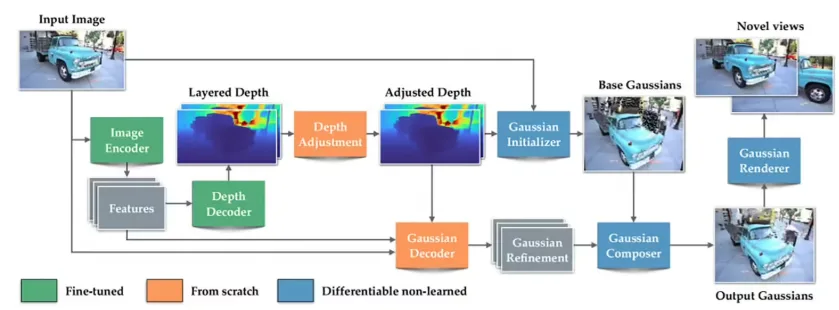
Although SHARP currently focuses on reconstruction near the original camera viewpoint and cannot fully recover occluded areas, its near-real-time conversion capability opens new avenues for mobile 3D creation and spatial computing applications. This technological progress reflects the AI industry’s shift toward efficient, real-time applications, foreshadowing widespread use in AR/VR, game development, and beyond—while also underscoring the critical role of chips and infrastructure in deploying large models at scale.