
In the current AI industry landscape, the launch of Apple's UniGen1.5 reflects the evolving direction of large model technology. The model breaks new ground by integrating three core capabilities—image understanding, generation, and editing—into a single system. Unlike traditional fragmented approaches, this unified framework significantly boosts the efficiency of visual tasks, relying on advanced algorithmic optimization and robust computing power, which in turn places higher demands on chip manufacturing. The research team emphasizes that the integrated design allows the model to leverage its understanding capability during image generation, producing higher-quality visual outputs—a demonstration of the potential of large models in multimodal interaction.
Innovatively, UniGen1.5 introduces an "edit instruction alignment" technique. The model first generates a detailed text description based on the original image and the user's instruction before executing the edit. This "analyze first, then operate" workflow effectively captures user intent and reduces errors, showcasing AI's progress in precisely handling complex instructions. In reinforcement learning, the team developed a unified reward system that is applied simultaneously to generation and editing training, addressing inconsistencies in quality standards and ensuring stable performance across diverse visual tasks. This highlights the core role of computing power infrastructure in supporting large model training.
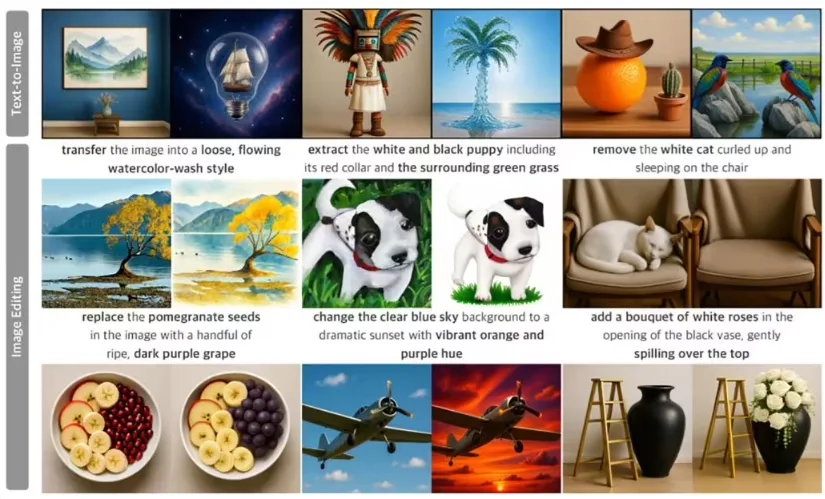
Multiple industry-standard benchmarks have validated its competitiveness: UniGen1.5 scored 0.89 on the GenEval test and 86.83 on the DPG-Bench test, significantly outperforming competitors such as BAGEL and BLIP3o. In the specialized ImgEdit evaluation, it achieved a score of 4.31, surpassing the open-source model OminiGen2 and matching the performance of the closed-source GPT-Image-1, demonstrating its leading position in the AI large model market. Nevertheless, researchers note that the model still struggles with generating text and may cause subject feature drift in certain editing scenarios, such as deviations in animal textures. Future improvements will focus on optimizing algorithms and enhancing chip computing power to meet the reliability demands of AI industry trends.