
Against the backdrop of rapid advancements in large AI models, generative AI is undergoing a critical transformation from "drawing accurately" to "positioning precisely." The InstanceAssemble framework released by Xiaohongshu significantly improves spatial alignment accuracy and semantic consistency in generated images with minimal parameter overhead—as low as just 0.84% extra parameters. This paves the way for applying AI generation technology in professional domains. As computing infrastructure continues to improve, AI generation is evolving from pure content creation toward fine-grained control, and InstanceAssemble embodies this trend.
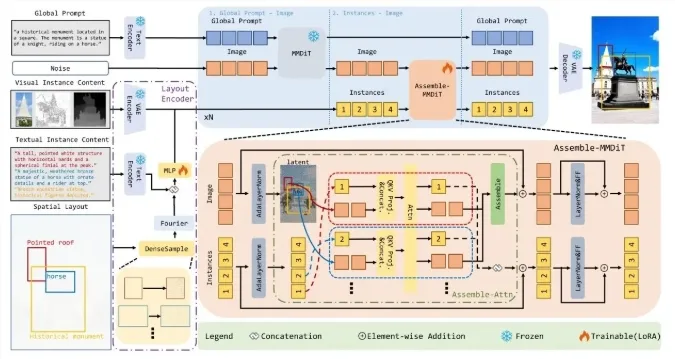
Traditional layout-to-image models often suffer from misalignment and overlapping when handling dense element arrangements, failing to meet professional requirements. InstanceAssemble innovatively adopts a cascaded two-stage architecture: first, semantic understanding parses the deep connections between text descriptions and layout instructions; then, a proprietary Assemble-Attention mechanism dynamically models relative positions, occlusion relationships, and hierarchical structures among instances, ensuring precise placement of each element. This breakthrough enables AI generation systems to comprehend complex spatial relationships, offering designers more controllable creative tools while lowering the technical barrier for professional content creation.
In terms of model adaptation, InstanceAssemble employs an ultra-lightweight LoRA adapter technology, requiring only 3.46% additional parameters to adapt the Stable Diffusion 3-Medium model, and as low as 0.84% for the Flux.1 model. This lightweight adaptation strategy not only reduces deployment costs but also allows users to flexibly inject layout control capabilities without retraining large models, supporting multi-modal instruction inputs including text, reference images, and bounding boxes. Such efficient adaptability is significant for advancing AI generation in edge devices and resource-constrained environments.

To address the standardization of layout generation quality assessment, Xiaohongshu simultaneously released the DenseLayout evaluation dataset and the Layout Guidance Score (LGS) interpretable metric. LGS quantifies generation quality from three dimensions—position accuracy, scale matching, and semantic consistency—overcoming the evaluation distortion of traditional metrics like IoU in dense scenarios. This initiative provides a unified benchmark for the industry and reflects Xiaohongshu’s sense of responsibility in promoting standardized AI generation technology, contributing to a healthier AI generation ecosystem.