
With the rapid evolution of large language model (LLM) technology, open-source models are becoming a critical driver for optimizing computing power infrastructure. Designed specifically for real-world coding scenarios and native AI organizational needs, the MiniMax M2.1 architecture not only showcases a breakthrough in computational efficiency through its 10 billion activated parameters but also leverages state-of-the-art (SOTA) technology to cover everything from atmosphere building to serious workflow execution. In performance evaluations, the model achieved an impressive 72.5% score on the SWE-multilingual benchmark. Moreover, on the newly released VIBE-bench test, it posted a commanding 88.6% score, outperforming closed-source models like Gemini 3 Pro and Claude 4.5 Sonnet. This highlights the unique advantages of open-source AI in resource allocation, offering developers a more efficient toolset.
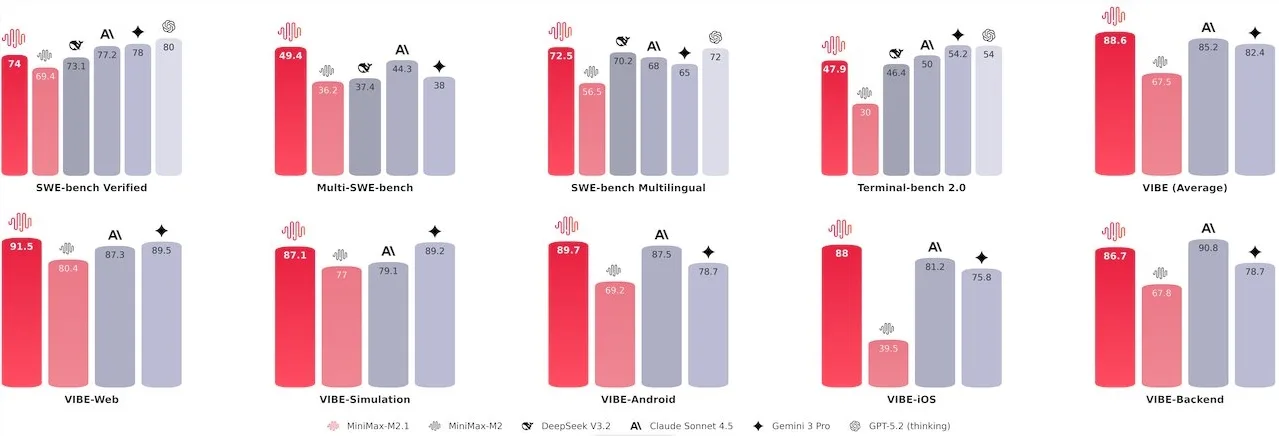
As the first comprehensive coding benchmark, VIBE-bench evaluates models across multiple dimensions, including web development, Android, iOS, and backend workflows, providing a scientific basis for assessing AI industry trends. MiniMax M2.1’s stellar performance on this benchmark not only confirms its leading multilingual capabilities in large language models—achieving SOTA results in languages like Rust, Java, Go, C++, Kotlin, Objective-C, TypeScript, and JavaScript—but also sees it surpass competitors with a 72.5% score on the SWE-bench Multilingual test. This underscores the adaptability of open-source models to global coding demands while driving the evolution of computing infrastructure toward higher performance.
The birth of this model was greatly accelerated by the support and feedback from early testing partners, developers, and ambassadors. Within the same week, the release of a competing GLM model followed closely with nearly identical SWE-Bench scores. This phenomenon powerfully demonstrates the potential of open-source AI to achieve high performance while maintaining openness, challenging the monopoly of closed-source models and fostering a more diversified AI ecosystem. Furthermore, MiniMax M2.1’s comprehensive excellence across indicators like SWE-Verified, SWE-Multilingual, Multi-SWE, and Terminal-Bench 2.0 reflects the core role of large models in the agent era. Its design philosophy emphasizes the elastic scaling of computing infrastructure to meet the complex demands of future AI applications.
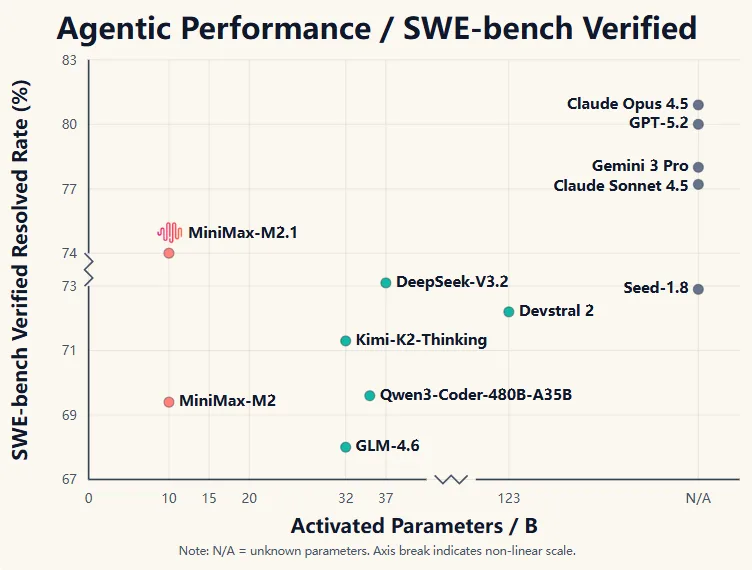
From an industry perspective, the rise of open-source models is driving synergistic innovation between AI chips and infrastructure. The success of MiniMax M2.1 signals that AI industry trends will increasingly prioritize openness and accessibility. This not only lowers the barrier for enterprises to deploy large models but also accelerates the process of technology democratization. Simultaneously, its robust multilingual support provides a broader collaboration platform for the global developer community, further solidifying the leadership of open-source AI in computing power optimization and laying a solid foundation for the widespread adoption of large language models.